 How-to
How to Laugh During Flights Without Annoying Anyone
Last Updated: November 19, 2026
Quick Summary
To laugh during flights without annoying anyone, keep it quiet and close to your chest, use headphones, and dim your screen at night. Share funny moments with the person beside you, and read the room during boarding, announcements, and turbulence. A small chuckle beats a loud reaction every time, and the people around you will appreciate it.
- Laugh into your chest rather than with your head back, which carries across the cabin.
- Watch headphone volume, since leaked earbud sound reaches the row behind you.
- Hold the jokes during boarding, safety demos, announcements, and tense moments.
- Dim your phone screen at night so it doesn't disturb your seatmate.
- Download comedy shows before you board, because cabin Wi-Fi often drops.
Table of Contents
- Why Laughing on a Plane Is Harder Than It Looks
- Funny Airplane Jokes That Work at 35,000 Feet
- How to Laugh Quietly in a Shared Cabin
- Funny Things to Do on a Long Flight
- How to Calm Down Before Flying With a Little Humor
- Airplane Etiquette for Passengers Who Want to Laugh
- Your Next Flight Starts With One Good Laugh
- Frequently Asked Questions
Nobody on a plane wants to be the person who laughed too loud during the safety demo, so learning how to laugh during flights without annoying anyone is worth your time. We get it. We have spent years in the cabin watching people try to giggle without waking the guy asleep in 14C. Here's what we've learned: you can absolutely laugh during a flight, and you can do it without annoying anyone. The trick is knowing where the line sits.
Cabin Pressure with Shawn & G helps travelers find that line, and this guide breaks it down from the aisle side of the curtain.
Why Laughing on a Plane Is Harder Than It Looks
A plane is a strange place to be funny. You've got 150 strangers packed into a metal tube, most of them tired, some of them scared, and all of them sharing the same air.
A laugh that's fine at a dinner table can land very differently at 35,000 feet. The person next to you may be trying to sleep. The kid two rows up may be melting down. Someone else may be gripping the armrest because they hate turbulence.
We see the same thing every flight. The guy who cracks up at his phone during takeoff gets a few annoyed looks. The woman who laughs quietly at a funny video with her earbuds in never gets a glance.
Quiet beats loud, and a shared moment beats a solo one. Keep that in mind and you're already ahead of most passengers.
Funny Airplane Jokes That Work at 35,000 Feet
Some jokes just play better in a cabin. They're short, they're light, and nobody has to pretend to be amused.
Here are a few types that tend to land well:
- Gentle observations about the seat. "I think this middle seat is my new personality."
- Self-deprecating jokes about your own travel mess. "I packed three chargers and zero socks."
- Light jokes about the boarding process. "Group 7 is basically a suggestion at this point."
- Puns about the flight itself. "I'm really looking forward to this flight. It's going to be a real lift."
Skip anything that targets the crew, other passengers, or the pilots. A flight attendant has heard every bad joke about the drink cart. Trust us.
If you're not sure whether a joke works, test it on the person sitting next to you with a smile first. Our piece on telling good aviation humor from bad can help you sort the winners from the groaners. If they laugh, you're in good shape. If they stare, save it for your hotel room.
How to Laugh Quietly in a Shared Cabin
This is the skill that matters most, and it's the one nobody teaches you. Being funny is easy. Being funny at 35,000 feet without becoming the story the crew tells in the galley takes a little practice.
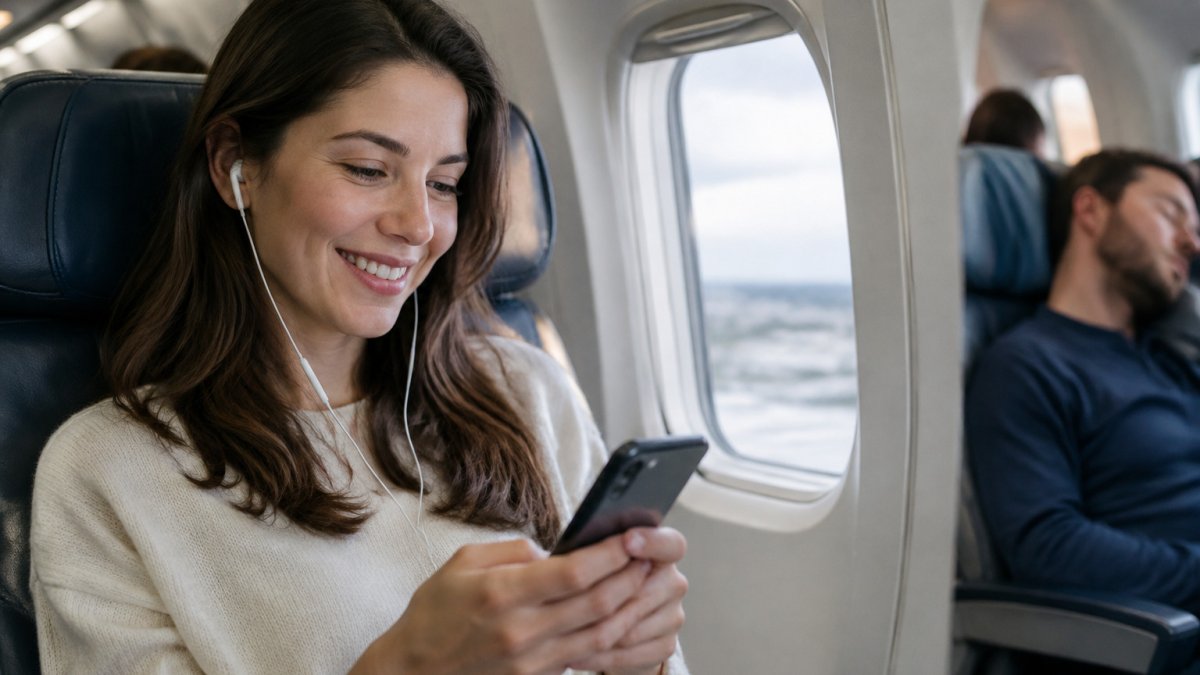
First, understand why a small laugh travels. A pressurized cabin is basically a metal room with hard surfaces, low ambient noise, and seats packed close together. Sound doesn't vanish; it bounces off the ceiling panels and slides along the floor to the row behind you.
Try these habits:
- Laugh into your chest, not the ceiling. A closed-mouth chuckle or a snort stays in your row. A head-back belly laugh is a cabin-wide announcement.
- Use headphones, and check the leak. Watch comedy, listen to podcasts, or scroll clips with the sound in your own ears only.
- Mind the screen brightness at night. In a dark cabin, a bright phone screen is its own kind of disruption. Dim it, and angle it away from your seatmate.
- Share the moment sideways. If something is funny, a quick smile or a whispered line to the person beside you lands better than a loud reaction and builds a small, quiet connection.
- Respect the sleepers. If your seatmate is out cold, keep the giggles in your chest and save the big reaction for the jet bridge.
Quiet laughing feels good too. You get the mood lift without the side-eye from the row behind you.
Watch out: earbuds turned too loud leak sound into the next row, and noise-cancelling headphones can make you misjudge your own volume. If the person beside you can hear your video, the volume is too high. If you can't hear yourself laugh, you're probably louder than you think.
There's also a timing layer. During boarding, the safety demo, and any PA announcement, the cabin is supposed to be listening, and a loud laugh reads as disrespect even if you meant nothing by it.
Here is a quick reference for the habits that keep your laughter from reaching the row behind you.
| Habit | Why it works | Watch out for |
|---|---|---|
| Laugh into your chest | Stays in your row | Head-back laughs carry cabin-wide |
| Use headphones | Keeps audio to your ears | Leaking earbud volume |
| Dim your screen at night | Avoids a glowing disruption | Bright screens in dark cabins |
| Share the moment sideways | Builds a quiet connection | Loud reactions feel intrusive |
| Respect sleepers | Protects their rest | Giggles during boarding or announcements |
Funny Things to Do on a Long Flight
Long flights test everyone's patience, and a few laughs can make the hours go faster. Here are some low-key ways to keep your mood up:
- Download a comedy special or two before you leave. Wi-Fi is spotty, so do this on the ground.
- Bring a funny book or a joke collection. Paper doesn't make noise.
- Play a silent game on your phone. Word puzzles and quiz apps keep your brain busy without disturbing anyone.
- Keep a running list of the weird things you see. It's a fun habit, and it's always entertaining.
Offline entertainment is your best friend. Our collection of funny real-life stories from flight attendants is a good thing to download before you board. Load up your devices before boarding, because cabin Wi-Fi drops the moment you need it most. If you want something to laugh along to, check out these funny aviation podcasts for travelers.
How to Calm Down Before Flying With a Little Humor
This is the part most articles skip, and it's the reason a lot of people search for how to laugh during flights in the first place. Plenty of passengers aren't looking for jokes to tell.
Here's the mechanism, in plain English. Our guide on practical decompression advice from flight attendants covers more ways to settle your nerves before you board.
Some ideas that work for nervous flyers:
- Queue up a favorite comedy for takeoff. Pick something you've already seen and know makes you smile, so you're not gambling on a new show while you're already keyed up.
- Download it on the ground. Cabin Wi-Fi is unreliable, and the moment you most want a distraction is the moment it drops. Load your phone or tablet before you board.
- Choose a light-hearted podcast with a familiar episode. A voice you know and like is oddly soothing, and it gives you something to focus on during the climb.
- Keep one small joke or funny memory ready for turbulence. Repeating something silly to yourself is a simple way to interrupt the spiral. It sounds goofy until you try it.
- Use captions and a considerate volume. If you're hard of hearing or flying with someone who is, turn on subtitles and keep the audio low so you're not disturbing the row. Non-verbal comedy works too, and a silent funny video can be just as effective.
Humor doesn't replace good preparation, though. If flying genuinely scares you, talk with a doctor or a licensed therapist about it, and treat humor as one tool among several. Official guidance from airlines and aviation authorities can also tell you what to expect on board.
One more thing worth saying: if you're the travel companion of a nervous flyer, your job isn't to make them laugh. It's to follow their lead. A quiet joke when they're ready helps. A loud one when they're gripping the armrest does not.
A little laughter can make a flight feel shorter. That's a win in our book, and it's the kind of thing we talk about on Cabin Pressure with Shawn & G when the mics are on and the coffee is strong.
Airplane Etiquette for Passengers Who Want to Laugh
Good etiquette is what separates a fun traveler from a problem passenger. Keep these rules in mind:
- Watch your volume at all times, especially during announcements and boarding.
- Don't record other passengers for a laugh without asking. Nobody wants to be your viral clip.
- Read the room. If the cabin is tense because of turbulence or a delay, hold the jokes for later.
- Follow crew instructions. If a flight attendant asks you to lower your device or stop something, do it with a smile.
Crew members actually enjoy a little lightness on a rough day. Show your crew pride with the Cabin Pressure flight attendant sweatshirt on your next trip. A friendly, quiet laugh with the crew can make the whole cabin feel better.
Our takeaway is simple: be the passenger who makes the flight easier for everyone around you. Laugh with people, not at them, and keep it low and kind.
Your Next Flight Starts With One Good Laugh
Next time you're boarding, try bringing one funny thing to share quietly with yourself or the person beside you. Whether it's a joke, a clip, or a funny memory from your last trip, a little humor makes the miles fly by.
If you want more stories from the cabin, listen to Cabin Pressure with Shawn & G wherever you get your podcasts, or catch us on YouTube. We'd love to hear what makes you laugh at 35,000 feet. Tell us in the comments: what's the funniest thing you've seen on a flight?
Frequently Asked Questions
How do you laugh quietly on an airplane?
Keep it to a smile, a silent chuckle, or a quick shoulder shake, and save the big belly laughs for after landing. Earbuds with a funny podcast or a show on mute with captions help a lot, because you can react without broadcasting it. If something truly cracks you up, a hand over your mouth and a short exhale usually does the trick. Cabins are shared spaces, so the goal is to enjoy the joke without turning your row into a live audience.
What are some funny things to do on a long flight?
Try sharing a funny story with the person beside you if they seem open to it, or pick a comedy special, a sitcom you have been meaning to watch, or a humorous book on your tablet before you board. Some passengers enjoy playing a light-hearted word game or sketching the people around them in a notebook without staring. Download your entertainment before takeoff, since in-flight Wi-Fi and streaming can be unreliable. Keeping a list of silly things to look for out the window can turn a long flight into a small game.
How can humor help calm nerves before flying?
Laughing can ease tension and gives your mind something to focus on besides the engines and the bumpy air. Watching a light comedy or listening to a funny podcast before takeoff can break the loop of worried thoughts. Humor does not replace good information, though, so check official airline and aviation authority guidance on what to expect during turbulence. If anxiety about flying is significant, consider talking to a healthcare professional, since humor is a coping tool rather than a treatment.
How do you keep from disturbing other passengers when you laugh?
Be mindful of volume and timing, especially on red-eyes or flights where people are trying to sleep. Laugh with your face and shoulders rather than your voice, and avoid sharing jokes out loud during boarding or the safety demonstration. If you want to share something funny with a neighbor, a quick whisper and a check that they are awake is a good rule. Remember that cabin crew are working hard, so keep any jokes with them respectful and brief.