 Listicle
Funny Stories From Airline Flight Attendants
Last Updated: November 1, 2026
Quick Summary
Funny stories from airline flight attendants usually involve passengers asking for things unrelated to the flight, such as a different seat because the view wasn't good enough, or a second dinner. Crews trade these tales at layover bars, often featuring confident passengers who are completely wrong about the rules.
- Strange requests often come from nervous first-timers, frequent flyers, and retirees alike.
- Seatbelt signs are safety instructions, not suggestions, and crews treat them that way.
- The call button is for real needs like medical issues or spills, not for asking about pretzels.
- Crews keep safety announcements exactly as required while adding friendly touches where they fit.
- Telling a crew member early about a fear of flying lets them check on you during the flight.
Table of Contents
- The Strangest Requests Flight Attendants Hear at 35,000 Feet
- Funny Flight Attendant Stories That Stick With Crews
- Weird Things Passengers Do on Planes
- Funny Airline Announcements Crews Actually Enjoy Giving
- Awkward Moments on Airplanes and How Crews Handle Them
- Where to Hear More Cabin Crew Stories Next
- Frequently Asked Questions
The Strangest Requests Flight Attendants Hear at 35,000 Feet
Here's a truth nobody warns you about before your first trip in the aisle: the strangest requests don't come from the people you'd expect. Nervous first-timers, frequent flyers, and retirees all have their moments. Funny stories from airline flight attendants almost always start with a passenger asking for something that has absolutely nothing to do with the flight.
We've heard requests for a different seat because the view "wasn't Instagram-worthy," for the crew to hold a baby while a parent used the lavatory, and for a second dinner because the first one "didn't count." Some of these are harmless. Some make you wonder what planet the request came from.
The lesson? Expect the unexpected, keep your sense of humor, and never assume a request is too weird until you've heard it twice. Funny stories from airline flight attendants are often born from exactly these moments.
Funny Flight Attendant Stories That Stick With Crews
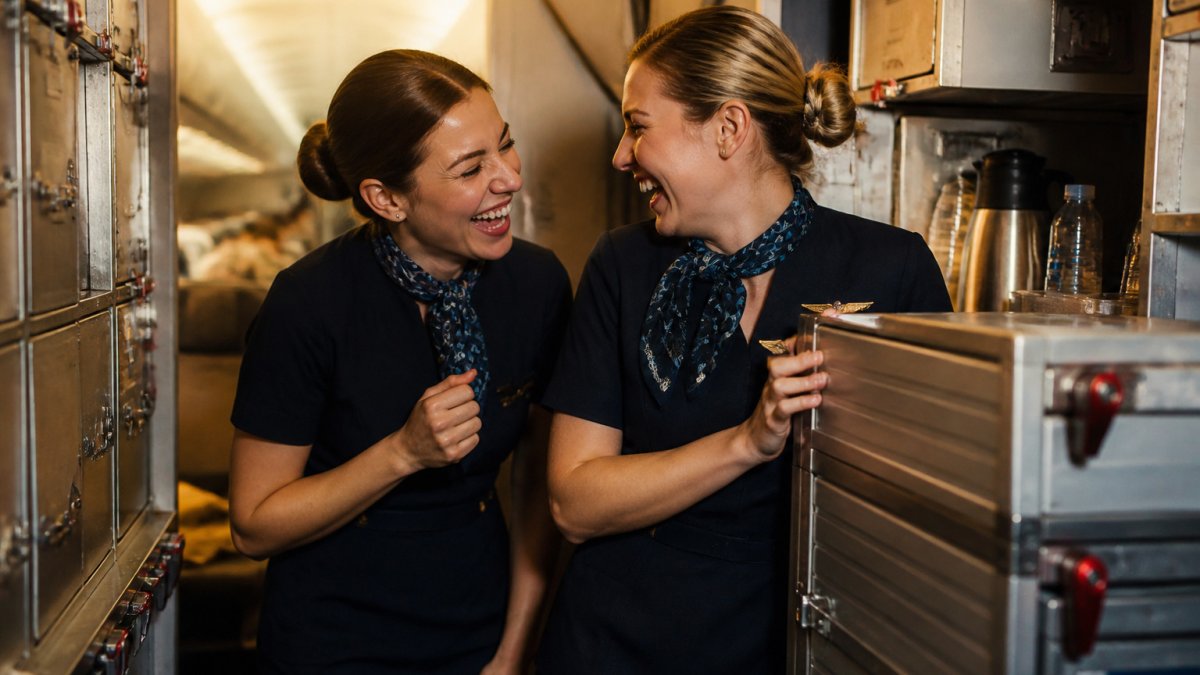
Every crew has a story they bring up at the layover hotel bar. The ones that get retold for years usually share three things: a specific situation, a passenger who was completely certain they were right, and a crew that had to keep a straight face while following procedure. Here are a few themes we hear again and again, organized by the kind of moment they come from.
The passenger who treats safety instructions as a negotiation
One flight attendant we know still laughs about a passenger who insisted the seatbelt sign was "a suggestion." He stayed seated, sure, but he spent the whole approach narrating his own plan to ignore it. The humor isn't that he was rebellious, it's that he was confident about something completely wrong. The seatbelt sign isn't a suggestion; it's a safety instruction, and it's there for a reason.
The toddler who claimed the drink cart
Another favorite involves a family traveling with a very confident toddler who decided the drink cart was his personal throne. Nobody was hurt, and everyone on that row still talks about it. What makes it a crew story is the choreography behind it, the cart has to stay secured, hot liquids have to stay put, and a crew member is quietly redirecting a small human while still pouring drinks for row 22. Some crew stories are funny for the crew, and some are funny for the passengers who never realized how much attention they were getting.
The row that wasn't theirs
A common pattern on long-haul flights: a passenger settles confidently into a seat that isn't theirs, falls asleep, and wakes up to a very polite conversation about seat assignments. It's funny in retrospect, less funny when the actual seat-holder is standing in the aisle with a boarding pass and a look. Crews handle it calmly because nobody wants a confrontation at 38,000 feet.
Why these stories get retold
The best ones are short, specific, and a little bit ridiculous. They also tend to come from a range of routes and roles, a domestic red-eye, an international long-haul, a regional jet with one flight attendant, which is part of why crews trade them. A note on how we tell them: identifying details like flight numbers, dates, and exact routes are changed or left out, and we don't name passengers. These are crew anecdotes shared in the spirit of the job, not a record of any one flight.
If you've got a story like this, you're in good company. The ones that stick are the ones where the passenger was sure, the crew was patient, and the punchline arrived somewhere over the wing. If you want to hear more of these tales told over a few drinks, you can listen to Cabin Pressure with Shawn & G, we trade plenty of them on the show.
Weird Things Passengers Do on Planes
Passengers are wonderful, honestly. They're also creative in ways that keep crews on their toes.
Here are a few patterns we see again and again:
- Bringing a whole kitchen. Pots, sealed containers, a full rotisserie chicken. Every airline has rules about food and cooking smells, and "it's just a little garlic" is not a valid argument.
- Treating the overhead bin like a personal storage unit. Someone always tries to stash a suitcase, a pillow, and three coats in a space built for one carry-on.
- Sleeping in the wrong row. Confident, comfortable, and absolutely in someone else's seat.
- Asking the flight attendant to find something in the bottom of their bag. Usually it's a charger. Sometimes it's a stuffed animal they swore they packed.
Weird passenger behavior is a big part of what makes this job interesting. Funny stories from airline flight attendants usually have a passenger somewhere in the middle, looking surprised that the rules apply to them.
Call Button Confusion and Other Cabin Etiquette Mix-Ups
The call button is probably the most misunderstood tool on the plane. It's meant for real needs: medical issues, a spill, a question that can't wait. It is not a doorbell for "can I get another pretzel."
We've seen passengers mash the call button for the lights, for the air vent, and once to ask whether the bathroom was occupied. Honestly, a few of us have seen someone grab a flight attendant by the arm instead of pushing the button. That one's a classic, and it's exactly the type of moment that shows up in funny stories from airline flight attendants at crew briefings.
The fix is simple: use the button for needs, and wave politely if you just want attention. We promise we'll come, usually before you've finished your wave.
Funny Airline Announcements Crews Actually Enjoy Giving
Most safety announcements are read so many times that they blur together. Crews tend to find small ways to keep them fresh, while still making sure every word that matters gets delivered clearly.
Some crews enjoy a light touch in the welcome announcement, like a friendly remark about the weather or a quick joke about the seatbelt. The safety content itself stays exactly as required. Passengers can tune out a lot, but the instructions about exits and oxygen masks are never the place for improvisation.
Crews also enjoy the moments that aren't scripted. A good-natured remark during boarding, a quick joke about the traffic on the runway, or a shout-out to the child in 14C who has been counting seats out loud. Those little moments are often what passengers remember, and they're some of the most rewarding parts of the job.
Funny airline announcements are fun, but the real magic is in the human touch that makes a long flight feel a little friendlier.
Awkward Moments on Airplanes and How Crews Handle Them
Not every story has a punchline. Some moments are just awkward, and handling them calmly is part of the job. What separates a crew story from a passenger horror story is usually the procedure behind the calm face.
Turbulence confessions
Turbulence can make people say things they wouldn't say on the ground. Someone mid-flight might confess a fear, a secret, or a very detailed opinion about the person in front of them. Crews learn to listen, reassure, and keep things moving. The context worth knowing: turbulence is a normal part of flying, and the seatbelt sign is the crew's main tool for keeping people safe when it picks up. If a nervous flyer is gripping the armrest, a quiet explanation of what's happening, and why the crew is still walking the aisle, often does more than a joke.
The spill that becomes a safety item
A spilled drink looks like a service problem. It's also a slip hazard in a moving cabin, and hot liquids near laps are a real burn risk. The crew response, towels and a check on the passenger, is calm, not improvised. That's the part passengers don't see: the calm towel handoff is a small procedure running in the background.
Lost medication and rough days
Other awkward moments involve lost medication, a passenger who is clearly having a rough day, or a seatmate who won't stop talking. The best approach is usually calm, quick, and kind. A glass of water, a clean towel, and a quiet check-in go a long way. Crews also know when to escalate medical concerns.
The etiquette fix that prevents most of it
Most awkward moments are preventable with a little cabin etiquette: use the call button for real needs, keep the aisle clear during service, and flag a problem early rather than hoping it resolves itself. If you're a nervous flyer, telling a crew member before departure is genuinely helpful, it lets them check in on you during the flight instead of discovering the issue mid-turbulence. For a deeper look at what goes on behind the curtain, check out Behind the Scenes Airline Secrets: What Crew Won't Tell You.
Awkward moments are part of the human side of flying. Handling them well is what turns a stressful situation into one that passengers remember for the right reasons, and it's why crews trade these stories on the layover.
Where to Hear More Cabin Crew Stories Next
If you're enjoying these funny stories from airline flight attendants, there's a lot more where this came from. We share real-world tales, behind-the-scenes insight, and plenty of laughs on Cabin Pressure with Shawn & G, our podcast about life at 35,000 feet. New episodes drop every Monday, and you can also watch Cabin Pressure on YouTube.
If you want to go deeper, check out our guide to Behind the Scenes Airline Secrets: What Crew Won't Tell You and our article on funny aviation stories for travelers. Curious about similar shows? We also put together a guide to podcasts like Betty in the Sky.
Have a story of your own from the cabin or the terminal? We'd love to hear it. What's the strangest thing you've ever seen a passenger do?
Frequently Asked Questions
What are some funny things that happen on airplanes?
Plenty, and most of them involve passengers doing something nobody planned for. Crews regularly describe passengers trying to fit oversized items into overhead bins that clearly won't fit, falling asleep in the wrong row, or asking for a specific snack that was never on the menu. Many of the funniest moments come from the gap between what a passenger expects and what the flight can actually deliver. Shawn and G have heard enough of these over their careers that the stories tend to repeat in new forms, which is a good sign the humor is grounded in everyday travel behavior rather than rare events.
What is the funniest thing a flight attendant has seen on a flight?
There is no single answer, and anyone claiming one probably has a great story they are saving for the right moment. Flight attendants often describe the funniest moments as small and unexpected: a passenger who insists the seatbelt sign does not apply to them, a child who announces the turbulence is fun, or a traveler who sincerely asks whether the captain can slow down the plane so they can finish a crossword. The stories that land best are usually the ones where the crew and passengers end up laughing together rather than the ones where someone is embarrassed.
What are some awkward moments that happen on flights?
Awkward moments on airplanes usually come from proximity. Two strangers share an armrest, someone snores loudly during the quiet hours, or a passenger reaches for the call button and accidentally hits a neighbor's shoulder instead. Crews see these moments constantly and tend to handle them with a calm, matter-of-fact approach that keeps everyone comfortable. Knowing that these situations are common can help nervous or new flyers feel less self-conscious when something similar happens to them.