 Listicle
Funny Stories for Business Travelers from the Cabin
Last Updated: November 17, 2026
Quick Summary
Funny stories for business travelers are tales like a suit bag losing the overhead bin battle, a client call started at the wrong gate, or a hotel lobby turning into karaoke. Each one carries a practical lesson that helps you avoid the same mess on your next trip.
- Keep the suit on board and the laptop under the seat, since bins fill fast.
- Check your gate on the airline app at boarding and an hour before departure.
- Ask at hotel check-in whether any events are booked during your stay.
- Local taxi drivers often know about road closures before navigation apps do.
- Avoid naming clients or bosses when seatmates can overhear your calls.
Table of Contents
- Why Business Travelers Need a Good Laugh at 35,000 Feet
- 1. The Forgotten Suit Ran Out of Space in the Overhead Bin
- 2. The Client Call That Started at the Wrong Gate
- 3. Hotel Surprises and the Lobby Karaoke Night
- 4. The Wrong Turn Between Meetings and the Taxi Driver Who Knew Better
- 5. Strangers, Seatmates, and the Unexpected Encounter in Row 23
- Pick Your Next Laugh: Podcasts to Keep You Company on the Commute
- Share Your Worst Work Trip Story With Us
- Frequently Asked Questions
Why Business Travelers Need a Good Laugh at 35,000 Feet
Funny stories for business travelers are more than entertainment. Stories like a grown executive losing a fight with a garment bag, or an attorney holding a client call from the wrong gate, are the kind of thing people laugh about once they land. Cabin Pressure with Shawn & G has collected these moments because a good laugh at 35,000 feet makes a rough trip easier to handle.
Business trips are stressful by design. Tight schedules, missed connections, and hotel check-ins at midnight pile up fast. A few funny stories remind you that the chaos happens to everyone, and that you can survive it. Here are a few common scenarios, with the lessons they carry.
Here is a quick scan of the lessons from the stories above, so you can pull the practical takeaways out fast.
| Scenario | Lesson | Action |
|---|---|---|
| Suit bag in full bins | Bins fill fast | Keep suit on board, laptop under seat |
| Client call at wrong gate | Gates change | Check gate on app at boarding and an hour before |
| Lobby karaoke during stay | Events not volunteered | Ask at check-in about events that night |
| Taxi detour around closure | Drivers know closures first | Ask the driver and watch the clock |
| Seatmate overhears work talk | Cabin can hear you | Avoid naming clients or bosses |
1. The Forgotten Suit Ran Out of Space in the Overhead Bin
Picture a consultant boarding a full flight with a suit bag slung over one shoulder and a rolling carry-on that was already at its limit. The bin above row 14 had room for exactly one more item, and the consultant was determined it would be the suit.
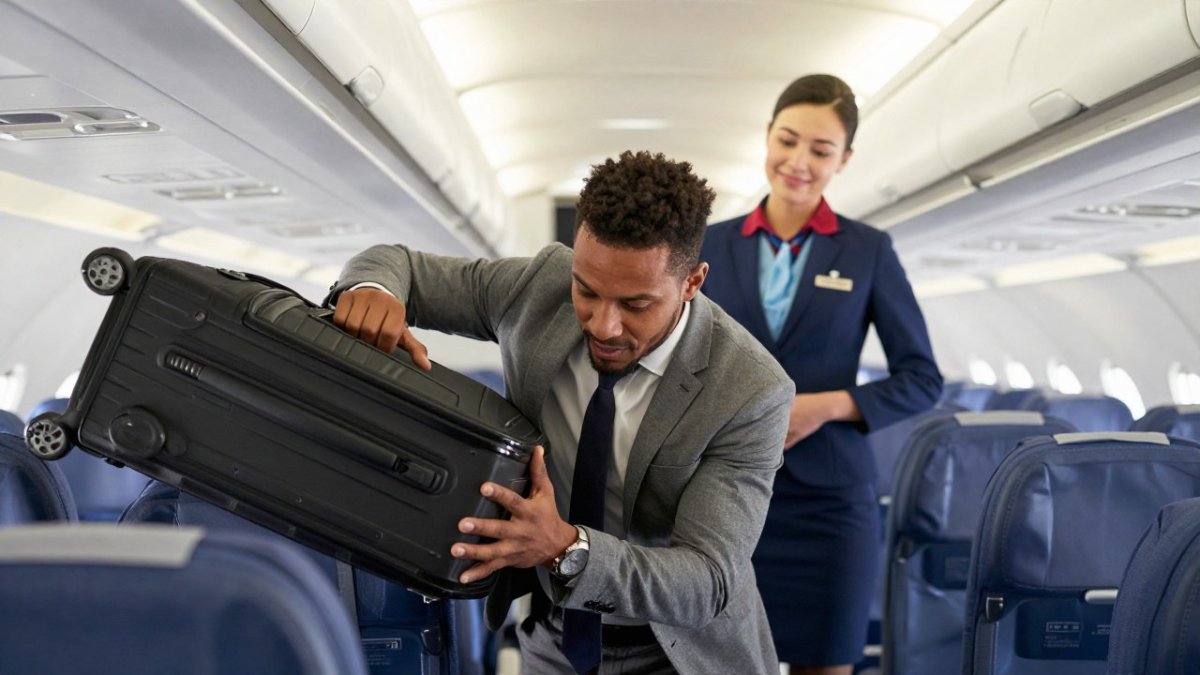
A suit bag is easier on the garment when it can hang flat rather than being folded into a bin. If the bins are full, asking about gate-checking the garment early is a sensible move.
Insider tip: Carry the suit on the plane and the laptop in the bag under the seat. Bins fill fast, and whatever you lose space to will go to the gate.
2. The Client Call That Started at the Wrong Gate
A regional sales director had a video call scheduled for the minute she was supposed to board. She sat down at Gate B12 to set up her laptop, and the gate agent announced that her flight was leaving from B21. She found out with eight minutes to spare and a bag full of printed slides.
She made it, barely. Her lesson stuck with us: check the gate on the airline app the moment you get a boarding pass, and again an hour before you leave. Gates change more often than most travelers expect.
Lesson learned: Set a phone reminder for the gate check. It takes thirty seconds and can save a client relationship.
3. Hotel Surprises and the Lobby Karaoke Night
Hotels are where business trips go to get weird. You spend all day being professional in a conference room, and then the building itself decides to test you. Hotels can complicate a business trip more than people expect, and the details often don't show up in the booking confirmation.
Consider a finance manager on a two-day audit in a mid-size city. He checked in after a long day of meetings, thrilled about a quiet room and an early night before the second day. When he came down to the lobby for coffee, the place had turned into a karaoke bar. Someone's birthday party had booked the entire space, the speakers were pointed at the mezzanine, and his room was directly above the stage. He did not get the early night.
That question is the whole takeaway. Hotel event calendars are not secret, but they are also not volunteered. A short call or a note in the reservation before you arrive is the difference between a quiet room and a front-row seat to someone's rendition of a power ballad.
Watch out: A "quiet room" request in the booking notes is not a guarantee. It is a preference the front desk tries to honor, and it loses to a wedding block every time. Confirm it in person at check-in and ask what is happening in the building that night.
There is a business-travel angle here that general travel-humor lists miss. A bad hotel night does not just cost you sleep. It costs you the version of yourself who can sit through a morning of numbers without yawning. If you have a presentation the next day, the room matters as much as the slides. Ask about events, ask about the floor, and if the answer is vague, ask to be moved before you unpack.
Another common mix-up is booking a cheap room near the airport and then finding the "airport shuttle" runs on a schedule that starts at six in the morning, leaving a midnight arrival to take a rideshare. The lesson is the same one we keep coming back to on Cabin Pressure with Shawn & G: the details you skip at booking are the ones that find you at midnight.
Lesson learned: Treat the hotel like part of the itinerary, not the background. Check the event calendar, confirm the room location at check-in, and verify the shuttle or transport schedule before you need it. Thirty seconds at the desk beats three hours of regret.
4. The Wrong Turn Between Meetings and the Taxi Driver Who Knew Better
An engineer had two meetings across town with forty minutes between them. He grabbed a taxi, gave the address, and watched the driver take a route that looked nothing like the map on his phone. The driver explained, in fairly blunt terms, that a road closure had added a bridge detour, and the phone had not caught up.
The driver was right, and the engineer made the second meeting with two minutes to spare. Our lesson: local drivers often know about closures before navigation apps do. Ask, listen, and keep an eye on the clock when you have a tight connection between appointments.
5. Strangers, Seatmates, and the Unexpected Encounter in Row 23
Our favorite stories often come from the seat next to you, and business travel is the only context where a stranger can become a client, a mentor, or a cautionary tale before the drinks cart arrives. The trick is that none of it is planned. You cannot schedule a good seatmate. You can only avoid ruining the one you get.
Picture a business traveler sitting beside a retired musician on a cross-country flight. By the time the drinks cart came through, they might be trading stories about bad hotel breakfasts, and by landing, the musician could have suggested a meeting for the traveler's next client. That is not a strategy. That is what happens when two people are not staring at their phones for four hours.
We have seen the opposite just as often. A passenger boards, puts in earbuds before the safety demo, and treats the seatmate like an assigned roommate they did not choose. That is fine. Nobody owes anyone a conversation.
Here is the part the general travel-humor lists skip. Seatmate encounters are a workplace-safety issue as much as a social one. You are in a confined space with a stranger, and the same rules that apply in an office apply at 35,000 feet. Do not share client names, do not complain about your boss by name, and do not treat the seatback pocket as a confidential document folder.
Watch out: A great seatmate conversation can turn into a pitch, a request, or a sales call before you land. If you are not in a position to follow up, say so kindly and early. A vague "let's connect" that goes nowhere is worse than a clean "great talking to you."
There is a practical takeaway buried in all of this. The seatmate encounter is a small test of the same skills that make a good business traveler: reading a room, setting a boundary, and knowing when to be human. You do not have to be chatty. You do have to be aware.
Seatmate encounters are a favorite topic on Cabin Pressure with Shawn & G, because the cabin is the one place where everyone's guard is down. If you want more of these stories between trips, the podcast is built for exactly this.
Pick Your Next Laugh: Podcasts to Keep You Company on the Commute
If you want more travel humor between trips, the Cabin Pressure with Shawn & G podcast is built for exactly this. New episodes drop every Monday, and the stories come from two airline veterans with a combined 89,000 hours in the air. You can listen to Cabin Pressure with Shawn & G on your commute, or watch the show on YouTube if you prefer video.
For more ideas, you might also check out funny travel podcasts worth a commute and the wider selection of best comedy podcasts for your commute. Our travel gear we use page also covers the bags and tech we rely on when the schedule gets messy.
Share Your Worst Work Trip Story With Us
Every business traveler has one: the missed connection, the hotel mix-up, the suitcase that took a detour to another city. We would love to hear yours. What went wrong, what did you learn, and how did you laugh about it later? Share your story, and it might end up in a future episode.
Frequently Asked Questions
What are some funny stories about business travel?
The best business travel stories usually involve small disasters that happen to busy people on tight schedules: a suit left in a hotel closet, a connection missed by four minutes, or a hotel breakfast buffet that closed right before a 6 a.m. meeting. What makes them funny is the contrast between the polished image of a business trip and the messy reality of getting there. Collecting these stories helps you laugh at yourself, and the lessons tend to stick: pack a backup shirt, check the gate twice, and always confirm your hotel reservation before you leave the airport.
What are some short, funny travel stories?
Short travel stories work best when they are built around one moment: a seatmate who insisted the armrest was theirs, a boarding announcement that was only half heard, or a rental car that turned out to be a very small hatchback. Keep them to a paragraph or two and focus on what went wrong and how the traveler handled it. Readers enjoy them most during a commute or while waiting at a gate, and the best ones end with a practical tip that saves the next person some trouble.
What are some funny things that can happen on a work trip?
Common funny moments on work trips include arriving at the wrong airport terminal, realizing the presentation file is only on the office computer, and being seated next to someone who wants to talk about their entire divorce. Hotel mix-ups are also popular, such as a room with a view of a parking structure labeled as a city view. These moments are easier to laugh about afterward, especially when you share them with colleagues who have had similar experiences.
What are some funny travel quotes for frequent flyers?
Frequent flyers often pass around lines like 'Airports are where you spend four hours to save forty minutes,' or 'Every trip has one seatmate story and I am still waiting for mine to be the good one.' Quotes like these work because they name a shared frustration in a light way. Used sparingly in conversation or a travel group chat, they help frequent travelers feel like they are part of a crew that understands the same delays and cramped seats.