 Listicle
How to Tell If Aviation Humor Is Actually Funny
Quick Summary
Aviation humor is funny to some people and baffling to others, and it depends on who is listening. Jokes built on universal experiences like middle seats and bumpy landings tend to work for almost anyone, while jargon-heavy lines land best with insiders. The gap between those audiences is where most of the humor lives.
- Short jokes built on universal experiences tend to land with almost any audience.
- Jargon-heavy aviation jokes work best for insiders who share the same context.
- Each aviation role hears the same joke through a different lens.
- Laugh about the job, never about real incidents or danger to safety.
Table of Contents
- Why We Keep Asking Whether Aviation Humor Is Funny
- Why Aviation Jokes Work: Jargon, Stress, and Shared Experience
- Short Funny Pilot Jokes That Land With Almost Anyone
- Flight Attendant Humor From Inside the Galley
- Clean Airplane Jokes for Mixed Audiences
- Air Traffic Control, Mechanics, and Passengers See the Joke Differently
- When Aviation Humor Crosses the Line on Safety
- Try One on Your Next Crew Member and See What Happens
- Frequently Asked Questions
Last Updated: November 8, 2026
Why We Keep Asking Whether Aviation Humor Is Funny
Every few months someone in our inbox asks us the same question: is aviation humor actually funny, or is it just a bunch of people who spend too much time at 35,000 feet? Shawn and I have spent a combined 89,000 hours in the air, and we still laugh at some of this stuff. We also cringe at plenty of it. So we figured it was time to give the question a proper look. At Cabin Pressure with Shawn & G, we think the honest answer is "sometimes, and it depends entirely on who is listening."
Aviation humor is a strange beast. A joke about a runway or a flight level can have a room full of pilots howling and leave everyone else staring at their drink. That gap is the whole story, and it's worth understanding before you decide whether a joke deserves your laugh.
Why Aviation Jokes Work: Jargon, Stress, and Shared Experience
Most aviation humor runs on three things. The first is jargon. Words like "heavy," "go-around," or "squawk" carry a precise meaning for people in the business, and a little double meaning makes them land harder for insiders. The second is stress. Flying involves long hours, tight schedules, and moments where people are genuinely on edge, and humor is one of the oldest ways crews let off steam. The third is shared experience. A joke about a delayed crew bus only works if you've stood in that bus.
That's why the same punchline can feel brilliant to a captain and meaningless to a passenger. Humor needs context, and the context in aviation is unusually deep. The funniest jokes are usually the ones that make an insider nod and an outsider say, "Okay, I get the gist."
Short Funny Pilot Jokes That Land With Almost Anyone
If you want a test case for whether aviation humor is actually funny, start with the simple ones. Pilot jokes tend to work best when they're short, plain, and built on a relatable image rather than a lot of technical setup. The reason is mechanical: a joke needs the listener to fill in a gap, and if the gap requires three minutes of flap-setting explanation, the laugh dies before it arrives.
Here are a few that travel well in mixed company, plus a note on why each one lands.
- "What's the difference between a pilot and a jet engine? The engine stops whining after you land." This one works because everyone has sat near a complainer, and the aviation wrapper is thin enough that a non-flyer gets it instantly. It's also self-deprecating enough that pilots usually laugh at it, which is the real test.
- "The autopilot is the most reliable crew member on board, it just doesn't pour the coffee." A classic because it pairs a genuine truth (autopilot does a lot of the cruise flying) with a mundane human task. The humor comes from the contrast, not from jargon.
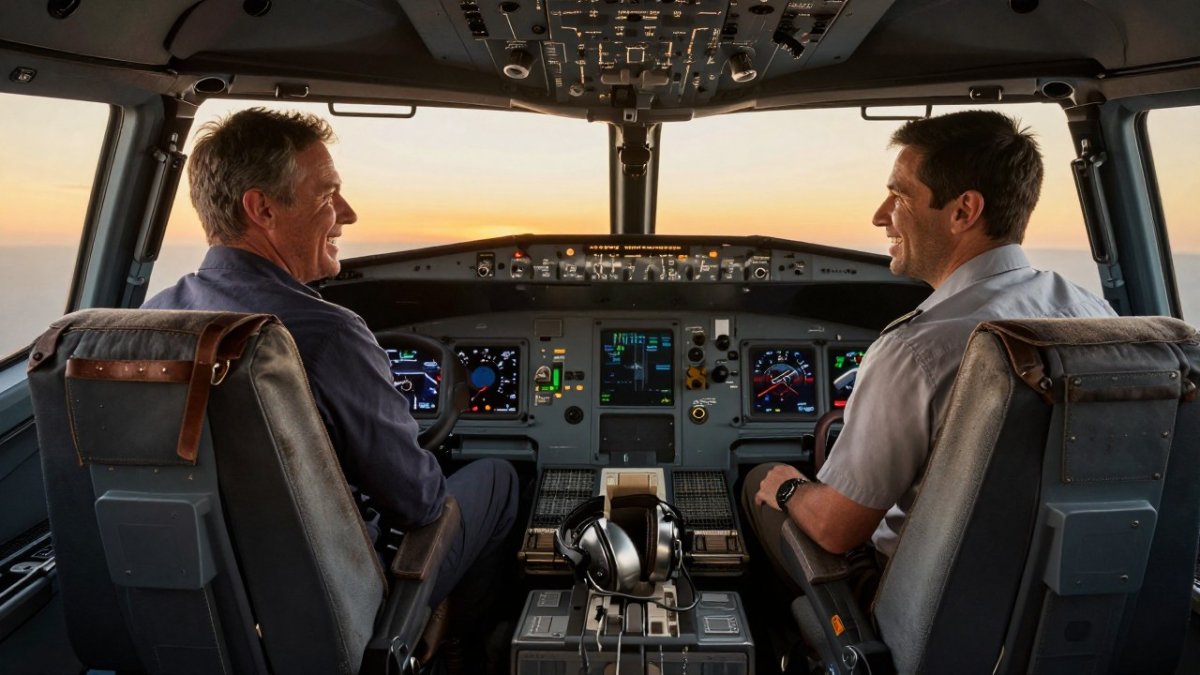
- "A pilot's prayer: 'Lord, grant me the confidence of a first officer who just said "watch this."'" This one is insider-adjacent. Newer passengers may not know the first officer role, so it helps to explain in plain English: the first officer is the co-pilot, the second-in-command who sits on the right. Once you know that, the joke about bravado lands.
- "I'm not saying the landing was rough, but the oxygen masks got nervous." A gentle exaggeration about turbulence or a firm touchdown. It works because almost every frequent flyer has a story about a landing that felt personal.
What do these have in common? None of them require you to know what a flight level is. They lean on universal experiences, whining, coffee, bravado, a bumpy landing, and use aviation as the costume rather than the punchline. That's the difference between a joke that gets a nod from the whole cabin and one that gets a polite smile from the two people in row 14 who fly for a living. If you want more of this kind of thing in your ears, the Cabin Pressure with Shawn & G podcast is where we swap these stories every week.
Watch out: the moment you start explaining the joke before you tell it, you've already lost the room. Deliver it clean, and if it doesn't land, move on. A pilot joke that needs a pre-briefing is a briefing, not a joke.
Flight Attendant Humor From Inside the Galley
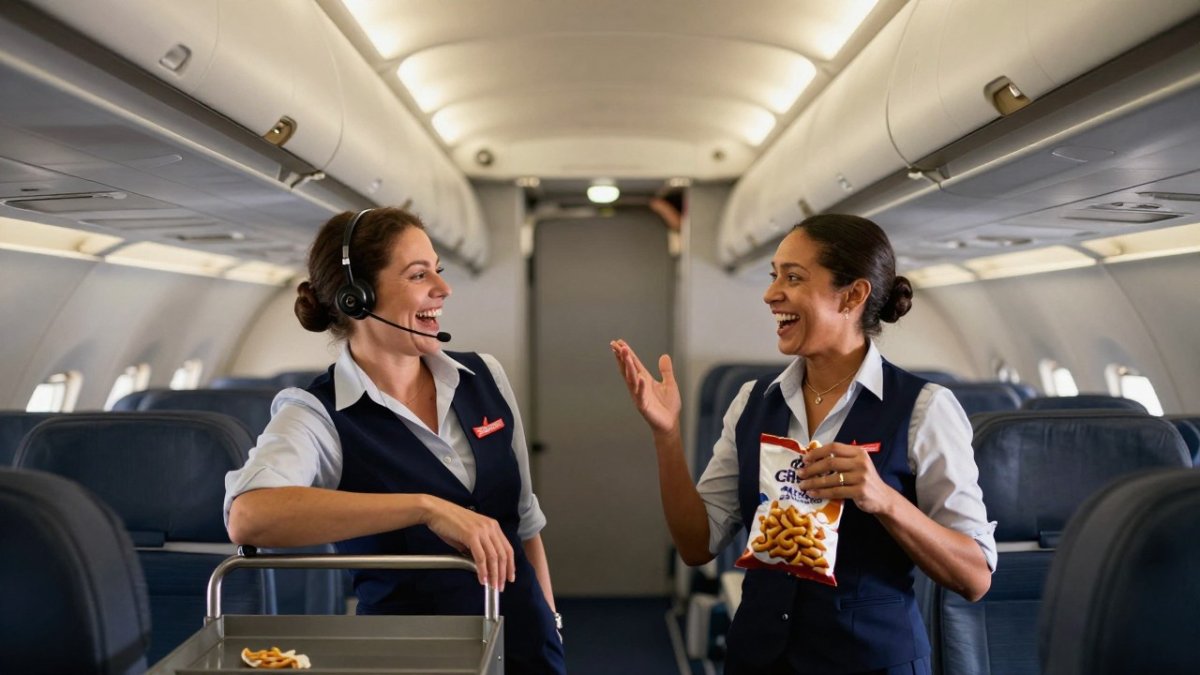
Now for the part we know best. Flight attendant humor is built in the galley, in the rare pockets of calm between boarding and service. It's dark, it's fast, and it usually comes at the expense of our own exhaustion or a passenger who asked for the impossible. Galley humor is a survival tool. A crew that can laugh about a turbulent service or a cranky first-class passenger is a crew that keeps its composure. That's why the jokes often sound harsher than they are. They're a pressure valve, not a personal attack.
Clean Airplane Jokes for Mixed Audiences
Not every joke belongs at a wedding or in front of a nervous first-time flyer. Clean airplane humor is its own skill. The best clean jokes lean on universal experiences: the middle seat, the overhead bin that won't close, the flight attendant who suddenly needs to walk past you with a cart. Puns about altitude, takeoff, or "going places" also play well with everyone.
The trick is to keep the sarcasm pointed at situations rather than people. A joke about the airline's boarding system will get a laugh from almost any room. A joke about a specific passenger will get you uninvited from the next crew party.
Air Traffic Control, Mechanics, and Passengers See the Joke Differently
Here's where things get interesting, and where most joke collections stop short. The same line can be hilarious to one aviation role and mildly alarming to another, because each group is standing in a different part of the same machine. If you want to know whether aviation humor is actually funny, you have to ask funny to whom.
Pilots tend to laugh at jokes about control, ego, and the gap between what the manual says and what actually happens. A line about a "quick fix" or a "routine" approach gets a knowing chuckle because pilots live in a world of checklists and procedures, and the humor comes from the moments when reality doesn't match the script.
Air traffic controllers have their own humor, and it's usually about workload, phrasing, and the sheer number of aircraft they're juggling. A pilot's favorite joke about a missed approach may baffle a controller who's sequencing a dozen arrivals, because the controller's stake is different: they're thinking about separation and sequencing, not about the view from the cockpit.
Mechanics and ground crew see the joke through a maintenance lens. A line about a "quick fix" can be painfully close to home because they're the ones who have to make the fix actually hold. Their humor tends to be about parts, paperwork, and the gap between what the logbook says and what the aircraft is doing.
Flight attendants, our people, sit in a unique spot. We're safety professionals first and hospitality workers second, and our humor reflects that split. Galley jokes about a passenger who asked for the impossible or a service that went sideways are pressure valves, not personal attacks.
Passengers are the wildcard. A nervous flyer may hear a joke as reassurance or as a warning, depending on how much turbulence they've just survived. A frequent flyer may get the reference and laugh along. A first-time flyer may smile politely and wonder what everyone else knows. That's not a failure of the joke; it's a failure of context. The humor is the same; the stakes are different.
That's a big reason aviation humor can feel exclusive. It's not that the jokes are bad. We talk about this a lot on Cabin Pressure with Shawn & G, because the gap between insider and outsider is where most of the real comedy, and most of the real awkwardness, lives.
Each group in the aviation world hears the same joke through a different lens, and the table below sums up how each one tends to react.
| Audience | What they laugh at | Where it can misfire |
|---|---|---|
| Pilots | Control, ego, and gaps between the manual and reality | Self-deprecating jokes aimed at named people |
| Air traffic controllers | Workload, phrasing, and misheard call signs | Pilot humor about missed approaches |
| Mechanics and ground crew | Parts, paperwork, and the logbook versus the aircraft | Drier humor that rarely travels outside the hangar |
| Flight attendants | Galley exhaustion and impossible passenger requests | Harsh-sounding jokes taken as personal attacks |
| Passengers | Universal experiences like middle seats and bumpy landings | Jokes heard as reassurance or warning depending on nerves |
When Aviation Humor Crosses the Line on Safety
This is the part we take most seriously. Humor about aviation is fine. Humor that makes light of a real incident, or that suggests safety procedures don't matter, is not. Flight safety is built on people taking the work seriously, and a joke that trivializes a near-miss can send the wrong message to new crew members who are still learning the rules.
Our rule of thumb is simple: laugh about the job, not the danger. If a joke would make a grieving family or a nervous passenger feel worse, it doesn't belong in a public setting. Crews know where the line is, and the good ones stay on the right side of it.
Try One on Your Next Crew Member and See What Happens
So here's our challenge. Next time you're on a flight, or in an airport lounge with someone who works in aviation, try a short, clean joke and watch the reaction. You'll learn quickly whether the room is in on it. If the laugh comes, you've found common ground. If it doesn't, that's useful too. If you want to see these bits play out with real crew banter, you can watch Cabin Pressure on YouTube, and if you want a reminder of the good times, our Cabin Pressure merch is a fun way to wear the joke.
We'd love to hear what lands for you. What's the aviation joke that made you laugh the hardest, and did anyone around you get it? Tell us in the comments, and we might feature the best ones on the show.
Frequently Asked Questions
Is aviation industry humor actually funny to people outside the industry?
Some of it is, and some of it is not. Jokes that rely on insider jargon, such as a reference to a specific checklist or a radio phrase, usually go over the heads of general passengers. Jokes built on universal situations, like waiting on a delayed flight or a passenger who tries to carry on a sofa, tend to land with almost everyone. If you want to test a joke, the simplest check is whether you can explain the punchline without using any aviation terms. If you can, it will likely travel well beyond the crew room.
Why do pilots and flight attendants use so much aviation humor?
Crew jobs involve long hours, tight schedules, and situations that can turn stressful quickly. Humor gives people a way to release tension and build trust within a team that may have just met an hour before departure. Jargon also works as a kind of shorthand, so a joke can signal that you belong to the group. That in-group quality is a big part of why the humor feels funny to crew and sometimes odd to everyone else.
What are some short, clean aviation jokes?
Clean aviation jokes usually work through wordplay or relatable airport frustration rather than anything crude. A classic example is the pilot who tells passengers the flight will be smooth, and then asks them to keep their seatbelts on just in case the coffee has other plans. Keep jokes short, avoid anything that mocks passengers personally, and never make a joke about a real incident. Those three habits keep the humor friendly for mixed audiences.